Thoughts on Education – 2/22/2012 – Getting a liberal arts education
Back to thinking about education after a couple of days doing other things. I’ve been trying to get something up here every day, but things have been so busy over the last couple of days, that I’ve been taking a quick way out a couple of days. So, I want to get back into thinking about some of the big educational ideas out there. There have been a few articles on getting an education, largely about getting a liberal arts education, that have passed through my Evernote, so I thought I’d bring them together here.
I wanted to open with this chart. It comes from a short article here. I don’t even really need to say anything about it, but I will anyway, as the chart is certainly provocative:
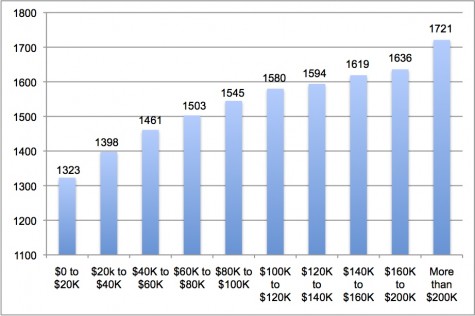
I guess the questions out of this are, what does the SAT really test and what does looking at a standardized test tell us about student progress. The first I learned from a summer of teaching for Princeton Review, which is that the SAT tests you on your ability to take the SAT. That’s about it, since if you know the tricks of taking the SAT, you can do well regardless of your actual knowledge. I can only guess that the fact that SAT scores increase as you go up in income probably reflects the greater availability of SAT prep courses as you go up in income. Or even sadder, maybe it’s that our whole education system is set up to help the richest succeed overall, so what knowledge that is tested on the SAT is more likely to come from the wealthy. On the other side is, of course, the question of how well a standardized test actually measures student ability or progress. Increasingly we come to rely on these high-stakes tests, but do they actually test ability, or do they just test access. In other words, if you are rich and can afford to send your kids to the best private high schools, are you more likely to do well on the SAT tests because of that. I don’t know the answer, but I suspect it’s a combination of all of this.
Then comes two articles on what value there is in the education that students get out of the college they go to. This discussion apparently followed out of a previous article about the ties between Wall Street and the Ivy Leagues. I’m not so interested in that, but I thought the further discussion about the liberal arts degrees and their relevance today were interesting. Of course, my own background as a history major makes me even more interested. I like this paragraph as a starting point from the first article: “Let’s say you’re a history major with a specialization in 18th century Europe from Yale. It may be that, from the economy’s perspective, your time at Yale taught you to think, research and write, which are all skills that can be used in a wide variety of upper-management positions. But that’s not what you think your time at Yale taught you. You think your time at Yale taught you about 18th century Europe. That’s what you spent all your time studying. That’s what you got graded on. And that’s why you’re nervous. There aren’t all that many jobs out there asking for a working knowledge of the Age of Enlightenment.” We talk about these skills that we expect our students at a community college to come out with, but I never really thought about the fact that students might not see or value those skills, as it is not obvious that is what they are really learning. It’s really a question of perception here. As Ezra Klein notes, “. . . it’s a problem that so many kids are leaving college feeling like they don’t have the skills necessary to effectively and confidently enter the economy.” While he is discussing high level education, I think there’s a similar problem at the community college level, as students are even more skills focused at that level. They want to know explicitly what the value of their education is. Simply telling them that learning history will be valuable in the long run doesn’t do much for them. Yet, when you point to these skills — the ability to read, write, think, evaluate, argue, and so forth — they don’t see those listed in the jobs they are seeking, even if those are the skills that employers might really want. I’ve heard this described before as college being short-hand for employers that a graduate has these skills, but that doesn’t help the actual graduate get a job if he or she does not know that they are valuable for that reason rather than for the degree they have. I think this is something we need to emphasize more from the college perspective, but I think that employers also need to be more open about it.
Following in that vein, there was a similar article discussing the results of a concentration on a liberal arts education. Daniel de Vise states – “We tend to offer some – typically our more disadvantaged, low-income populations – a more limited education that may prepare them for jobs for two or three years before they need to be re-trained. Meanwhile, we tend to offer others – disproportionately a more privileged group – a lifelong, liberal education that appreciates over time, preparing them for entire careers, and for jobs that may not even exist yet in our rapidly evolving economy.” We certainly go with the first side at the community college level because that is what we see ourselves as, as much technical trainers as transfer teachers. We do think of ourselves as teaching transfer students in the standards, but the reality is that many of our students are even pursuing a degree for the work advancement that it can bring. And this article comes back to that issue of skills. What he calls “liberal education” is at the center of the transfer of those skills from the Klein article earlier, in that a liberal education delivers an ” education that focuses on the development of capacities such as writing, effective communication, critical thinking, problem-solving, and ethical reasoning. These skills are practical, transferrable, and essential for the life-long learning that we all need if we are to thrive in a world that is complex, diverse, and ever-changing.” He warns against taking away that education in focusing in on technical education in fields that might not last or in training that will have to be renewed soon. Again, I think we need to emphasize these skills more. And, I guess I’m pointing to myself here, as I never really make it all that apparent that these are the valuable skills in the whole process. I know we get caught up in the specifics of our subjects, but delivering a course as simply learning history or english or math or whatever will never be as valuable to a student as learning skills for the real job market out there. As well, if our students graduate or transfer only knowing that they have accumulated the correct courses to graduate, then they will not see the value of what they are learning. Of course, as I noted above, if employers aren’t honest about what they want out of a college graduate, then those skills won’t be seen as valuable either. They need to be explicitly sought in the job market for it to be relevant for me to tell students that they are learning these valuable skills. It has to be a circle starting somewhere, I guess. But should it start from my end or from the employers?
On the theme of a degree telling employers something, this article on the value of a graduate degree is also relevant. As noted, a master’s degree or higher “signals to employers that recipients can complete a demanding program and that they have already been vetted by an institution.” It denotes a set of skills rather than a specific skill. While nothing in this article is particularly groundbreaking, it really just extends the last two I’ve discussed here into the graduate realm. Of course, the value of the graduate degree does vary by field, and I found their graphic to illustrate this well:
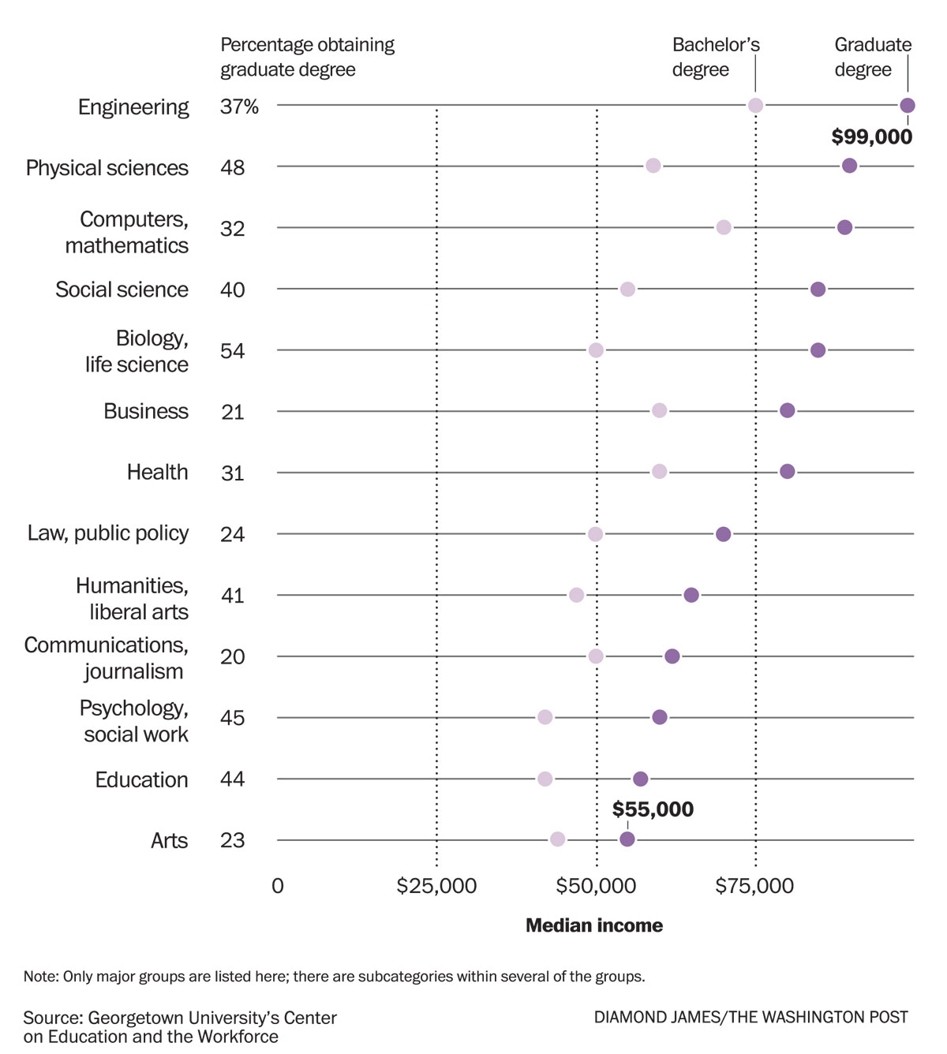
This, or course, shows that for me, there was a bump for getting my degree, although certainly from a lower level to start and a lower gain as well. Also, as noted a master’s degree is quickly become a standard rather than an option. This is true for me. So, regardless of the skills that I’m supposed to have learned from my degree, I simply had to have it. I could not have gotten my current job without a master’s degree, regardless of what skills I actually gained. And this, of course, is the other side of all of this I’ve talked about today. If the degree is a symbol of skills learned, then we have to be teaching those skills. I think I am, but are we all? Does every college education show those skills? Just something to think about.
Thoughts on Education – 2/21/2012 – A day with publishers
I got a few of my own things done today, including teaching a class, but the majority of today was taken up with activities involving publishers. This was not a bad thing, it’s just different from normal. It was all with a single publishing company, which shall remain nameless. I met with two representatives just before my first class today, and that was very productive. They represent the book that I am currently using and also represent the book that we are probably going to be adopting starting this next school year. It’s not the exact same book, but is instead the brief edition of the one I’m using now. We discussed some of the issues and problems I’ve been having, and it would have been nice to talk to them longer, as we could certainly have talked more at that point. It was nice, as I do like the one-on-one (two-on-one here) interaction, especially with a product that I am currently using.
After my class today, the representatives took the history people out to lunch, and we had a great time just chatting and eating good food. I don’t go to On the Border much, but what I had was very good. It is funny, as they had this symbol used in the menu that represented “healthy choices,” but it was only on three items out of the whole entire menu. I ended up with a fajita salad, which was not marked as “healthy,” but I left off the sour cream and guacamole, which made it not very bad for me at all.
Came back to campus for a bit of office hours and finished up a few things, then it was a drive to Irving. Long drive. A huge accident at the 121/183 split backed up for miles and led to a very long and slow drive. Finally, I made it to the hotel where the history focus group was being held with the publishers. Essentially, they were showing off their product and getting reactions from us as to what we liked, what we didn’t like, and what we would change/improve. I had seen most of it before and was the only one there who had used all of the products shown. Unfortunately, since I do like to talk, and since I had a lot to say about the products that were being used, I probably did talk too much. Still, I hope it was helpful to the others there, and I hope that what I had to say was also helpful to the publishers. It was an interesting evening, but i know that it was more helpful to them and the others than it was to me specifically. It was not a wasted evening by any means, and I did like discussing the material. I also ran into a couple of people from my earlier conference in Key West last fall, but I must say I liked that format better than this one. I know the intention is different, and Key West is nice as well, but I just like delving into the issues over a 2 1/2 day conference better than over a 2 1/2 hour conference. I felt like we just were not able to go into much detail and kept having to move on, whereas I would have loved to just keep going. I guess that’s the education nerd in me, as I could just talk and talk and talk about this stuff all day long. Probably better to keep it short anyway, as I would have just continued to talk otherwise.
And now, I’m back home. Tomorrow, I’m going to have to get to the actual grading I need to do, but it was nice to do something very different for a day.
Thoughts on Education – 2/18/2012 – Who can achieve academic success?
Back to your normally scheduled educational blogging. I’m feeling better finally, and I’m going to take a bit of time to blog here before starting on my main job for today, which is going to be grading.
‘Academically Adrift’: The News Gets Worse and Worse
The beginning has to be the continuing discussion of the assessment of how much students learn in their college education. The latest information that has been released shows a further problem with our higher education system: “While press coverage of Academically Adrift focused mostly on learning among typical students, the data actually show two distinct populations of undergraduates. Some students, disproportionately from privileged backgrounds, matriculate well prepared for college. They are given challenging work to do and respond by learning a substantial amount in four years. Other students graduate from mediocre or bad high schools and enroll in less-selective colleges that don’t challenge them academically. They learn little. Some graduate anyway, if they’re able to manage the bureaucratic necessities of earning a degree.” With teaching at a community college, I do, unfortunately, see mostly those from the second half. And, as I know from experience, when people think of college students, they don’t think of the students I have. Instead, as has been noted, the people who talk about educational policy mostly come from that first group and the people who create educational policy come from that first group. Students like mine are generally ignored in the debate about what to do about academics, which is why I often find the advice and discussion about education to be somewhat irrelevant to who I teach. In fact, even the failures of my students (and there are many) are generally seen as a failure on the part of the student. We blame the students for failing, even when they come into a system not designed for them and where their needs and abilities are not dealt with in a constructive manner. I don’t mean to say that the community college system or my community college is failing, it is just that when I have an expectation that 30-50% of my students will either withdraw, fail, or get a D out of my course, then we have to be working at a different standard. You don’t see that at elite or even normal 4-year colleges, yet most of what you see out there that involves higher education deals with those students. There are some community college specific resources, but they don’t drive the national conversation about education.
As this report shows, that bottom level of college students are more likely to come out of school with few skills and few prospects, where the likelihood is that they “are more likely to be living at home with their parents, burdened by credit-card debt, unmarried, and unemployed.” And, that makes it more difficult to justify an education to the students and to justify the cost of that education to those who pay for it. Of course, as I have noted so many times, articles like this love to point out the problems, but they never say much of anything about solutions. In fact, the implication of the end of the article is that maybe this research isn’t really correct and that we need to do our own research to find out the real truth. But I see the failures every day. We know that a certain number of students will simply never make it through, no matter what we do. It is sad, but it is true. But are we giving value to the rest of the students is the real question. I hope that we are, and I know that our current assessment craze is trying to prove that. I guess I don’t have anything more profound than that to say about it. It is definitely one of those things that makes teaching hard and makes justifying the money and time spent on teaching hard. But the question to ask always is, would we prefer a system where we never give any but the top people a chance at an education?
I came across two other related articles on teaching that I thought I would talk about for the rest of this blog post:
Colleges looking beyond the lecture
I picked this one because it is one of the things that pisses me off over and over in reading articles about changes in teaching. Here’s the reason: “Science, math and engineering departments at many universities are abandoning or retooling the lecture as a style of teaching, worried that it’s driving students away.” Where are the humanities and social sciences in this? Why is it only STEM that is trying to make changes. Yes, I can find a few history sites out there, but overwhelmingly if you’re talking about changing up education or the use of technology, it comes back over and over to STEM as the place where changes come from. So, wonderful, colleges are looking beyond the lecture in these areas because students aren’t succeeding with the lecture. Does that mean the lecture is working elsewhere? Or is it because the lecture is such an expected part of other areas of education that we don’t even question its utility.
So, the article goes on to talk about the challenges of the lecture system — low student learning, the ability of students to get the same information elsewhere, and low retention. What is interesting is the last part of the article that talks about the solutions, which is mostly to stop lecturing. While they don’t use the term “flipping” the classroom in this article, that is what is discussed over and over. So, nothing really new over things I have discussed in the past. What is interesting is that most of the solutions talk about “experimental” classes that are tiny in comparison to the large lecture classes. But, is that an acceptable solution? Obviously, we have large classes because that’s what makes the most monetary sense, and we are not going to switch to a situation where there are no more big classes. So, I found the solutions here to be unrealistic.
At M.I.T., Large Lectures Are Going the Way of the Blackboard
This article is certainly related to the last, and I include it here, as this is the direction that everyone looking at education reform is looking at, based simply on how many articles there are out there. It is, of course, also what I am considering, which is why I pull every article like this out to look at more closely. But then, what do I see? “The physics department has replaced the traditional large introductory lecture with smaller classes that emphasize hands-on, interactive, collaborative learning.” Back to STEM. Back to ending the large classes. Sigh.
Of course, if we had the money and resources, I would certainly jump at trying this: “At M.I.T., two introductory courses are still required — classical mechanics and electromagnetism — but today they meet in high-tech classrooms, where about 80 students sit at 13 round tables equipped with networked computers. Instead of blackboards, the walls are covered with white boards and huge display screens. Circulating with a team of teaching assistants, the professor makes brief presentations of general principles and engages the students as they work out related concepts in small groups. Teachers and students conduct experiments together. The room buzzes. Conferring with tablemates, calling out questions and jumping up to write formulas on the white boards are all encouraged.” But, we don’t have that type of classroom, those types of rooms to work with, teaching assistants, or anything like that. Plus, as the first article made the distinction, is this something that only works with the top level of college students or could it work for the bottom as well? A big question that I do not know the answer to. But since this is where the current push to change the system is going, I am trying to find out all that I can.
That’s why I started with the first article, as I think that we do design and think about the top level of students first, but that often leaves the bottom level out. And, I teach a good portion of students who are at that bottom level. I am trying to change their opportunities, but so often it does seem like the solutions I’m looking at require more money, time, and resources than are available to me. And yet, we’re also facing continuous budget cuts because even at the level we are now, we seen as being too expensive. I don’t know what this means, but it does make the job more difficult. Being innovative, creative, and improving student success on the cheap is very difficult.
Thoughts on History – 2/13/2012 – State of the Field
Two articles were delivered into my email yesterday on the state of the field of history. So, I thought I would write about them, having gone through the dissertation process myself (without completing it) and teaching history now. I certainly have my own opinions, and I’m sure that will come through here.
What’s Been Lost in History (As a note, I got this off of some place that allows me to read the full article. You have to have a subscription to read it on the Chronicle’s site.)
This is a fairly common-sense recounting of the problems with the job market for people pursuing a Ph.D. in history. He notes that the typical history department prepares students for a single profession, that of being a professor in a tenure-track job, doing research and a bit of teaching as necessary. If you do not aspire to that, the current state of history graduate education is not designed for you. While I did not go through the program looking for a nonacademic job, as this article focuses on, I still was an outsider, as I quickly discovered that I was much more interested in teaching than research. In fact, I spent 5 1/2 years in a Ph.D. program trying to convince myself that I could do enough of the research side of things to get through with the Ph.D. and hopefully get a teaching job somewhere. In the end, I left with a good amount of teaching experience, so I am thankful for that, but the emphasis on producing researchers was undoubtedly the only acceptable focus in my experience, just as this article discusses. As he says, “I do not have solid evidence on this point, but I think the notion of academe as the only suitable outcome of doctoral education is a myth generated by the highly untypical period from the mid-1950s to about 1970. My sense is that the historical profession (and the human sciences generally) became much narrower and more academic in the decades after World War II.” I think it is stuck in a rut, just as I’ve been talking about with other aspects of teaching in this blog so far. Why do we get taught this way in doctoral programs, because that’s the way they were taught. We even talked about the comprehensive exams as an archaic hazing ritual, done because that’s what our professors had to do.
His solution is to make the history degree more of a “pre-professional degree” than just one that leads to an academic research career. Acknowledge that many people who go into history will get a law degree or a museum placement or (like me) a teaching job. He advocates linking up history with “public affairs, business administration, international relations, social work, and journalism” as well, which would strengthen historical thinking and reasoning across the professions. Make it into something that people have more options with. When I left my undergraduate institution with a degree in history, I never got any real guidance on what I could do outside of going to grad school. Nobody ever talked about other options, and I went to grad school largely because I really didn’t know what else to do. There were no real connections to other fields, outside of one class that was only tangentially connected to the history department that looked at public history. I also got an internship at a museum in the summer before my senior year, but it also never really led to anything. All paths pointed to grad school, with no real alternatives given. So, there I went. And there was a very focused program with little ideas outside of research.
As he says, “Doctoral training in history as it developed in the 19th century included a commitment to civic life and leadership; in the first half of the 20th century, history was at the core of civic professionalism, partly because the social sciences generally were then historicist.” I will go even further to say that it is not just doctoral history, but history at all levels. This is something that I have been struggling with here in this blog because it has to do with the relevance of the subject that I teach directly. Is history just the memorization of facts at the undergraduate level or the research of some minutia that somebody else hasn’t found yet at the graduate level? I hope that it is more than that, and I like the civic aspects and the preparation for other careers that are discussed as alternatives in this article.
I guess that the more I look back on it, the more disappointed I am in my undergraduate and graduate education in preparing me for what I am actually doing now. Perhaps that means I was not suited to do history as I did, but I love teaching it, and I’m not sure how else I could have gone through the process without getting the teaching experience ahead of time to be able to get the job I did get. It just seems somewhat hollow when I look back on it. One of my friends in grad school said it best — everything he wanted to do in history you could do without a Ph.D., while everything you did to get a Ph.D. in history was not anything he wanted to do. Yet, idealistic people keep going in, with the hope that they will be the ones to buck the system. Hopefully one of them succeeds, but for now, I will try to do my best from a lower rung in the academic ladder.
Coming out of the American Historical Association (I should probably join this again at some point) is apparently a new effort to define what it means to get a history degree at the “associate, bachelor’s, master’s and doctoral” levels. Right now, there is no definition of that at all, and each institution’s degree is fundamentally different from each other one (I might even argue that each student’s experience in each program is fundamentally different). Of course, at my community college, you can’t even get an associate degree in history at all, so that’s a fascinating concept in and of itself. And, most importantly, this effort will not be about what is taught (the specifics), but about the competencies that one would expect to come out of a degree in history. In other words, this is another in the line of the assessment push now. It will be interesting to see how this turns out. Is it going to be a hollow change that ends up not meaning much, or will it provide some legitimacy and direction, much as was discussed in the previous article.
I don’t know that anything that I saw here will fundamentally change what I’m doing in the classroom, and it was interesting to see that the competencies here were basically the exact things that I already try to emphasize. But some commonalities would be good, especially if you could combine what was in this article with the previous one. I do think it would be even more valuable at the higher levels, as the graduate level is often even more amorphous. Some structure and variety in instructional ideas and techniques could have the potential to bring about changes. I guess I’m less optimistic there, but you would hope that things would change at some point to open up a field that is so singularly focused.
Thoughts on Education – 2/12/2012 – Is Technology the Solution?
I haven’t had much time to sit down and think about education since Thursday. It’s funny how the weekends slip away from you. I do have a big backlog of articles after having not done them on either Thursday or Friday, so I’m going to stick with more reviews today. I haven’t quite figured out what’s a good mix here, more of my own stuff or more article reviews. Of course, even in the article reviews, I am including a lot of my own thoughts as well. Right now, I’m doing article reviews when I get 4-5 articles I want to look at. However, I do look at so many places for information through the week, that it is honestly quite hard not to have that many articles to examine.
Using Technology to Learn More Efficiently
OK, so to start, just ignore the large Jessica Simpson lookalike on the page there, as distracting as her stare is there. I was interested in the article from the title, which is what gets me to save most of them for review later. So, often as I’m sitting down here to write about them, I am reading them for the first time as well. Sometimes they are so irrelevant or don’t do what I want that I simply don’t do anything with them at all, such as this one today. This one almost got a delete as well, but the concept is at least interesting, even if it links up to an older style of learning that I don’t want to encourage in my own classroom — flash cards. The article profiles a company that is digitizing flash cards and remaking them to encourage better retention and more honest use of flash cards. The more compelling idea is the creation of a schedule and the push for accountability to the students to complete their work. As the article notes, this is really an attempt to reduce the unproductive cramming before an exam and open up a broader studying schedule. However, the ultimate limitation here is the students. They are the ones who have to make the decision not to cram at the last minute, and I have a feeling that the students who would do this with this program would be the same ones who would be least likely to put off all of their learning to the last minute anyway. Still, I’m all for accountability, especially if it could be integrated with that idea from yesterday on using Google Docs to gauge student progress. So, maybe as a tool that an instructor could put together and release to the student, this could work.
The Gamified Classroom (Part 1, Part 2, Part 3, Part 4)
“Today, students are expected to pay attention and learn in an environment that is completely foreign to them. In their personal time they are active participants with the information they consume; whether it be video games or working on their Facebook profile, students spend their free time contributing to, and feeling engaged by, a larger system. Yet in the classroom setting, the majority of teachers will still expect students to sit there and listen attentively, occasionally answering a question after quietly raising their hand. Is it any wonder that students don’t feel engaged by their classwork?”
This, again, goes back to the issues I’ve talked about in several other posts, especially the last one. If we are talking about student engagement, then I think we are failing with the lecture model, especially to the most current generation of students, which is who this article series concerns. I just have to look out at my own classes on lecture days to see the problems, with maybe 1/3 paying active attention, 1/3 paying occasional attention, and 1/3 completely disengaged from the material. Of course, is gamification the answer? Of course not. But can we learn something from this educational trend? Very likely. Perhaps it can bring in greater engagement and even foster creativity rather than rote learning.
The role of technology can both help and hinder learning. The article refers to a number of ways that technology can help engagement, through having the students involved in project based learning and higher levels of engagement, using both apps and clickers. What is interesting is what the author sees as one way that technology is reducing that engagement as well, the smartboard. I’ve not seen that criticism before, as the smartboard is often held up as one of the prime ways to engage students. “Unfortunately, our classroom is often filled with technology that only exists to better enable old styles of teaching, the biggest culprit being the smartboard. Though it has a veneer of interactivity, smartboards serve only as a conduit for lecture based learning. They sit in front of an entire classroom and allow a teacher to present un-differentiated material to the entire group. Even their “interactive” capabilities serve only the student called upon to represent the class at the board.” I have been suspicious of smartboards as a save-all, but I had never really been able to figure out why I didn’t like them. I find this argument compelling. From my own point of view, they seem to just be a new version of the chalk board, offering nothing more than you can find with the method.
“In schools, our students should be using technology to collaborate together on projects, present their ideas to their peers, research information quickly, or to hone the countless other skills that they will need in the 21st century workplace–regardless of the hardware they will be using in the future. If we’re just using tech to teach them the same old lessons. . . we’re wasting its potential. Students are already using these skills when they blog, post a video to YouTube, or edit a wiki about their favorite video game. They already have these skills; we have to show them how to use them productively and not just for entertainment. This is where Gamification comes in. Games are an important piece of the puzzle–they are how we get students interested in using these tools in the classroom environment.” I agree. Ha! What I always tell my students not to do, present a big quotation and say they agree, but I guess I’ll hold myself to a lower standard than them. Still, I think this is an insightful look at the problems with just throwing technology at the problem. You can’t just hand teachers technology and expect them to transform everything. Technology is not the solution, although effective teaching with effective technology could be part of the solution.
The last two Parts of the series deal with how this might take place in practice. I’m not going to go through all of that here, as the information is diverse and hard to summarize. So, check it out if you’re interested. I think what is most interesting is the push for self-pacing and self-motivation for students. Tying completion to rewards beyond simple grades and pushing the students to do more. This is an interesting idea, but I do wonder if our students are ready for this. That is always the problem with these articles, that they project these things into an ideal world where students are not motivated because we aren’t motivating them. Yet, the real problem is often much more complex. Our students are as varied as can be, and the reasons for motivation or lack of motivation are varied in the same way. How do you motivate students who are working two jobs, taking care of kids, sick, taking care of sick family members, in school only because their parents think they should, in school only because they think the should, and so forth. In other words, when students aren’t required to be there, such as at college, how does this push differ? Something to think about.
The loss of solitude in schools
And, I’ll close for today with an opposite view. Here, the author is warning against the push for project-centered education, one where we emphasize interaction and group work over individual absorption of material. She makes the case that education is inherently a solitary process, where we engage with and absorb difficult material until we learn it. As she says, the emphasis on group work and interaction produces students that “become dependent on small-group activity and intolerant of extended presentations, quiet work, or whole-class discussions.” In other words, they forget how to learn on their own.
She also notes that the push away from the “sage on the stage” can be just as damaging for students. “Students need their sages; they need teachers who actually teach, and they need something to take in. A teacher who knows the subject and presents it well can give students something to carry in their minds.” I have never done much with small group work, so I can’t say one way or another how this works. I have generally done either lecture or discussions. I don’t know how to evaluate small group work, and so I have not done it. Perhaps this is short-sighted of me, but I just don’t know how to give a grade for group work that is not just on the end project. In other words, how do you hold everyone accountable? I know, from talking with my wife and remembering my own experiences, that group work is inherently unequal and very frustrating for those who want to do a good job, as they generally end up doing most of it. I don’t want to put students in that position, and have never been much for this idea. I could be convinced otherwise, but I am skeptical on the idea of small group work. I know that many of the changes I’m looking at making involve small group work, but I just don’t know what to do with it.
Anyway, enough for today. Please let me know what you think or if you have any responses to the ideas I’m presenting, as I don’t want to be working in a vacuum on this.
Thoughts on Education – 2/11/2012 – A revolution in the classroom?
Here’s a breakdown of the articles on education I’ve come across recently.
We’re ripe for a great disruption in higher education
The core of her argument is here: “But the real disruption comes when you stop measuring academic accomplishment in terms of seat time and hours logged, and start measuring it by competency. As all employers know, the average BA doesn’t certify that the degree-holder actually knows anything. It merely certifies that she had the perseverance to pass the required number of courses.” She is projecting a time when everything is going to be overturned. Where it’s not just the point where online courses take the place of face-to-face courses, but where the whole model of how we teach gets overturned. Who knows if she is right that this is going to happen anytime soon or in our lifetime, as revolutions are predicted all the time, but the argument is certainly compelling. Alternatives to the 4-year, sit-down degree have been growing, and at some point, it is easy to see us reaching a point at some time where we have fewer and fewer “traditional” students. Even now, I know that we could fill as many online classes as we could offer at my community college. My history ones always fill in a day or two after they open, and we could keep going. Of course, then there becomes the question of who is going to take the traditional classes if we just have more and more online classes? Right now, we limit the alternatives, forcing most students to take a traditional, face-to-face class. And, right now, there is a distinct population that wants that. However, at some point we are going to stop being able to keep that gate closed, and students will start going to places that offer more flexibility. The other thing that occurs to me on reading the article is that even our most “non-traditional” offering at my community college, the online course, is still strapped into the traditional course calendar. It starts and ends at the same time, and the guidelines we are given have the students not able to work ahead but instead completing the course like a traditional course. Breaking those boundaries will become necessary I think. We should be moving to classes that are self-paced, classes that work outside of a semester schedule, classes that can be completed in 4-, 8-, 12-, 16-, 20-, 24-weeks or whatever. Classes that start at odd times and classes that end at odd times. I can see the day, at some point, where we have rolling enrollment and completion on a student’s schedule. The student registers and starts, finishing up when he or she finishes, with assignments graded as they come in. We create the content, monitor the course, are available for consultation, feedback, and assessment. In other words, the day where a lot more places look like Western Governors University. And, the scary thing is, I don’t think that’s a bad thing.
Using Google Docs to Check In On Students’ Reading
And, if we are going to move to this more self-paced model, then we need to have better tools to check in on our students as they are doing their work. So, this article’s title certainly seems to go along with that. This is a quite interesting use of Google Docs. He details how to create a spreadsheet to keep track of where students are and what they are doing. As it is shared among all students, everyone can then see whatever common dimension you are looking for. In his case, he was having common reading and having the students post up before each class on how far they had read. That way he knew roughly where all students were, including a class average that gave a decent idea of how far most students were. I could see this used in a lot of different cases for common assignments in a traditional class or with a self-paced class, you have to post up to that in order to keep track of each individual student’s progress as they make their way through a self-paced course. I could see something like this really working well at tracking students on those types of assignments that they do outside of class that don’t have specific end points/assessments (like textbook reading and the like). That gives you another way to check progress rather than just waiting on them to complete a chapter test. The only thing this relies on is the students accurately and honestly recording their progress. I do think this would matter less if you were thinking about a self-paced course than one where it would be embarrassing for a student to show up to class not having read the required reading. With a self-paced course, this tool could also serve to remind the students at regular points that they should be working on some piece of the course.
Harvard Looks Beyond Lectures to Keep Students Engaged
This article was a bit shorter and lighter on substance than I thought when I posted it up to Evernote to read later. Still, it does cover some of these same ideas that something needs to change, as I think many of us can agree. In this case, Harvard is dealing with the problem that “researchers already know what works to promote deeper thinking and learning and it’s not sitting in lectures, taking tests, and then moving on to the next topic. Instead, students need the opportunity to make meaning of what they’ve learned and apply it to real-world challenges.” I can certainly agree with that. What I don’t buy is the last section, which implicitly tells us to wait for Harvard to make its decision on how we should change things, and then we can all rely on their expertise and change afterwards. I’m not waiting for them, and I don’t think the field is either.
Resistance to the inverted classroom can show up anywhere
I’ll close today with this one, which goes back to a concern I raised in the first article. “Many students simply want to be lectured to. When I taught the MATLAB course inverted, all of the students were initially uncomfortable with the course design, some vocally so.” Challenging the way things have always been done is going to lead to resistance. The student in a lecture class is in a passive role. Little is asked of that student, and they can just go through and do the minimum and do fine. Show up, take a few notes, and we will consider you to be learning. I hear that all the time from my colleagues (not going to name any names here), that the students they have won’t even take notes in class. I wonder two things about this.
First, is taking notes the thing we are seeing as the highest level of learning? I hear that more than anything else, that if you aren’t lecturing and the students aren’t taking notes, then learning isn’t happening. I go the route where I give all of my students my lecture notes ahead of time, which they are welcome to bring to class or use a laptop/tablet to access in class. I have had a number of students comment positively about that, saying that it allows them to actually pay attention to what is said in class rather than furiously trying to take notes on it. I’m not sure when it happened, but we seem to have elevated taking notes on a heard lecture to the highest form of academic achievement. Yet, I have plenty of students who don’t take any notes who do well and students who take a lot of notes who struggle.
Second, listening to a lecture and taking notes on it is the most passive of activities for a student. It might seem active to watch the pencils flying out there in class, but, at its heart, this exchange requires very little of the student beyond paying attention. There are not a lot of jobs out there where the ability to listen to 75-minute lectures and take notes about them is going to be a regular part of what they are asked to do. Yet, that seems to me to be the primary skill that we ask of the students. And while it is, why would a student want to change it. All they have to be is a listener and a note-taker.
Of course changing out of the model is going to breed resistance. If you told me that instead of sitting and listening to a lecture, I had to actively participate, presenting my opinions, engaging the material, and thinking and doing, I would have resisted as well. I can’t say it a lot better than this author did: “What I think this illustrates is that there is a cultural expectation about how college classes ought to go that is very hard to change. Many students — and faculty! — in higher education are sold on what I called the renters’ model, which is basically transactional. I pay my money and inhabit this space while you take care of my needs, and when I’m done I’ll move on. The inverted classroom is one style of teaching that insists on ownership. There will be some friction when two fundamental conceptions of class time are in such disagreement with each other, no matter how much sense it might make in your content area.” It is something I worry about on a regular basis about making change to my class. The question is, do we let expectations hold us back or do we move forward anyway and try to change those expectations?
Thoughts on Education – 2/8/2012 – Articles, including a crazy one from 9gag
I’ve saved up a couple of days worth of information on education here. I can’t say there’s a strong theme here, although several do have to do with games in education, which continues to be something that interests me. Here are some of the highlights of what I’ve been reading:
Khan Academy: It’s Different This Time
I’ve read a lot about the Khan Academy, and the overall direction of the coverage is generally quite positive. It is generally talked about as revolutionary to the current state of education. This is a rare piece that offers criticism. I have only explored Khan Academy a bit myself, mostly looking at topics covered without really engaging the material. Thus, I’m really relying mostly on what I have read elsewhere about the Khan Academy more than my personal experience. Also, as a note, the Khan Academy has a lot more math and science than it does humanities, so it usually gets evaluated in terms of these offerings. Still, this is a good counterpoint: “Khan Academy’s style of teaching is identical to what students have seen — and rejected — for generations: do this, then do this, then do this. Today, thousands of American students are performing poorly in math, in large part because they weren’t taught it correctly in the first place.” From what I have seen, there is definitely a point here. As the article says, the real problem is that the students are taught that all they need to do is memorize how to complete the task and not understand why completing it is important to know. The article also goes into a bit on skepticism of “new” breakthroughs that I can take or leave. It also notes the general positive reviews regarding “engagement” among students and the gamification aspects. Yet, I think that first critique is the most cogent and relevant. It is along the lines of what I have been worried about here. Is it more important in history to memorize what happened or to understand why what happened is important? I would certainly argue the latter, but I can’t speak for math in general. I’d love to hear from someone about the math side of things to see if this is a good argument or not.
Despite Focus on Data, Standards for Diploma May Still Lack Rigor
I do have to be honest here that I was linked to this article from another (Reeding and Riting That XPlane Why Stoodents Are Not College Ready), which is obviously a more eye-catching title. However, it quickly got into minutia about the New York area that seemed irrelevant here. So, I went to the original article. It discusses the problems with a single test being presented for all students as what they need to pass. As the writer argues, “If the standard is set too high, so many will fail — including children with special education needs and students for whom English is a second language — that there will be a public outcry. But if the standard is set too low, the result is a diploma that has little meaning.” What this means, in his estimation is that the tests have erred on the latter side, with multiple examples given of passing essays that use barely passable English. His basic conclusion is that testing-based evaluations have failed to increase the actual abilities of the students and just result in watered down tests to get students through who have not improved. The relevance for me is that these are the students (in TX rather than NY, of course) that I get. Somebody made an interesting comment to me two years ago that we are now seeing the students who have been raised through most of their formative years in a testing-focused school environment before college. I certainly see the limitations and largely agree with the article. Of course, the problem here is that it offers no actual solutions, outside of stopping doing what we’re doing now. From my perspective, I need to know how to deal with these students when they get to me.
Are you ready for a revolution in education?
I know, a 9gag link is not exactly scholarly, but then you have to get ideas where they come from, and I do search the linking sites, especially reddit. I don’t know if I can recommend that people get on reddit, as it has a lot of junk and is mostly amusing. However, I have found the education, teaching, and higher education sub-reddits to be a great source for articles. Honestly, I get about 60% of my links from there. This one is an example of something completely off the wall, namely the reorganization of a class around experience points (XP) such as you would earn in an actual game. It sets up a system where students earn XP for completing tasks. They can then use that XP to level up in the class while also using the points to gain advantages (like extra time on a test). It’s interesting and got my mind working. I was halfway through creating a way to use XP in my own classes before I even realized it. So, the idea is compelling. Realistic? I have no idea, but certainly compelling.
Using Role Play Simulations to Promote Active Learning
Along the same lines of gaming came this article. It talks about bringing in concepts from role-playing to substitute for the traditional lecture and offers three pieces of advice. The first and last are good, and if you’re interested in role-playing projects, then you should definitely check them out. The middle one is the one that caught my eye, because it encapsulates one of my biggest fears in making dramatic changes. The author notes that you have to assure the students that doing something different is ok and that they will be assessed fairly. Here’s the relevant part: “Most students are used to their teachers feeding them the information, so this will be a new experience for them. Addressing student anxieties about this way of learning is particularly important in disciplines or universities where the lecture-essay-exam model is the most common. I’ve found it helps to provide students with examples of work produced by students in previous courses. You also want to be clear in communicating your expectations. Write out the rules and requirements, and enforce them so the process is predictable. Make sure the teams are small enough that everyone participates and spot check to see that everyone actually does what they are supposed to – the free-rider problem isn’t going to go away. Also, take into account that, depending on their personality or culture of origin, some students may need extra encouragement to participate.” I will definitely take those ideas in mind when working on recreating my course.
7 Strategies to Make Your Online Teaching Better
- Let the technology help you, not hinder you – expect things to go wrong when you do new things. Don’t get flustered and help the students through the rough parts. The author recommends making tutorial videos and the like, but I think the biggest thing, which I have found to be true, is expect to be troubleshooting through your first week or two. This is something I certainly need to remember, as I get frustrated easily and often take it out on students through overly-sarcastic responses.
- Anticipate the difficulties – know that online students will be distracted, will get bored, will not spend the time you think is adequate, and all together approach the class in a way that you do not expect. The author suggests providing much “scaffolding” to keep students from getting lost and keep them moving in the right direction.
- Incorporate synchronous opportunities – online office hours and the ability of students to get a hold of you when they are likely to be doing the work and encountering problems. In other words, not in normal, traditional office hours.
- Give extra feedback. Then give more – I was going to write that I think I do this poorly, but then I read the advice here and see that I do all of it. I guess it’s the nature of online classes, that I always feel like I need to do more since I don’t see them in person. Yet, I guess I do ok here. I just always feel that I need to be providing more personal feedback to each student. But, as I teach 90 students online right now (a little less than half my load), and will have that probably go up even more next year, I’m not sure how realistic extensive individual feedback is. Still, I do need to think about this one.
- Prove you are not a dog – make sure the students know you are a real person with real issues, real problems, real experiences, and such. Don’t be a robotic responder. Have some personality, and the students will appreciate it.
- Provide support for self-regulation – encourage the students to take charge of their pace of work and requirements each week. We can only hold their hands so much and must rely on them to get things in on time. As I see it, you can only be so flexible, again with 90 students, there’s not a ton of leeway on getting things done and providing individual exceptions.
- Encourage play – While I have thought of this one, this is well put and something I certainly fail at. I will leave it with a quotation here: “Online courses often have a reputation of being dry and boring: lots of reading and lots of lectures. Adding in other elements can make all the difference in the world: add pictures when you can, consider design principles in your CMS, record your lectures in front of a small, live audience (I once recorded a weekly email from my campsite, replete with kids shouting in the background and a fly buzzing around my head). The point is, recognize both how you want to teach the information and how it might be received. I try really hard not to be boring.” I fear my class is boring. I get compliments organization and the like, but I think it is fundamentally not all that interesting of a course. This is something I should really work on.
I’m going to close here, as I’m approaching 1750 words. I have one more article on my list, but this is probably enough for a single post. Give me any feedback that you have. I’d love to hear what you have to say, and I’d love to hear what you have to say.
Thoughts on Education – 2/7/2012 – Evaluation and Assessment
Sorry for yesterday’s lack of a post. I decided to take the evening off and watch some shows with my wife and then go to bed early. We were watching In Search of Myths & Heroes from the BBC on Netflix. We watched 2 of the 4 episodes last night, one on Shangri-La and one on King Arthur. Not the most groundbreaking show in the world, but I did enjoy it. We had watched an earlier episode on The Queen of Sheba, but I didn’t really pay enough attention to that one to saymuch one way or another. The fourth myth is going to be Jason and the Argonauts.
On to education. I had another conversation with my Dean today regarding the future of the educational system. I had remarked that I have seen a larger number of students already skipping class than normal at this time of the semester. Informally, I have heard the same from other colleagues as well. It is always an interesting phenomenon, as to when students stop coming. I’ve had about 1/4 not showing up already, which is a bit early, as that level of absence usually doesn’t come until after the first major graded assignment, which is still over a week away for me. What is also interesting, as I’m thinking about it here, is that my highest level of attendance is always in my smallest section. I get 1/4-1/3 loss in attendance over the course of the semester in a 40-person class, but I will have perfect or near-perfect attendance in my two-way video section that only features 15 students directly in front of me. I wonder if that’s another advantage of smaller classes, in that there are fewer places to hide, so more people come. Just a theory. Anyway, from there, our conversation turned to hybrid classes and the problem of evaluation/assessment. He presented a compelling idea that we have discussed before, namely simplifying down the grading standards. Right now, we use a 5-point system, A-F to determine a person’s grade in the class. Yet, some of those grades are basically useless. The D is a grade that means nothing. You don’t fail if you get one and have to appear in front of the Academic Appeals committee, but you don’t get any real credit for the D and have to repeat the class. There’s also a case to be made that a B or C aren’t all that different. That does not mean that they aren’t different now, but that, in reality, both basically mean satisfactory completion and mastery of the material. Then, an A is excellent. So, what if we went to a model where instead of A-F, we just had three grades — Excellent, Satisfactory/Mastery, Failure. As my Dean said, those are the real grades that matter to the students. Most are just looking for satisfactory, while a few really want to push it the extra mile into Excellent. The rest will Fail. Any thoughts on that?
Another interesting idea that we discussed is how you would evaluate on that scale. Actually, we talked about the whole evaluation/assessment process. The problem with any class that moves beyond just a standard model for assessment (quizzes, tests, essays, etc.) is that the grading automatically becomes more subjective at that point. Instead of being able to point to a number that the student earned, you have to look instead at a feeling about the student from the performance of the student in the class. I can’t take credit for this, as my Dean is the one to give this example, but I like it, so I am repeating it here. The example is that if I go through a semester with a group of students, doing primarily discussion and class work as the fundamental assessment, then I will, at the end of the semester, be asked to assign a grade. It will be a grade that will be hard to justify, as I would not be able to tell someone coming in a specific number grade that the student earned. Yet, I would be able to evaluate the progress and aptitude of the student well, as I interacted with that student over the course of an entire semester, having that student talk, discuss, evaluate, participate, and create different projects, discussion, and writing. I would be very confident in the grade that I gave the student, but I would not be able to justify it in the traditional manner. However, if I was to give a student a B or Satisfactory, I would be confident in that evaluation. My Dean also pointed out that I could probably ask colleagues to come in and evaluate that student or ask how that student presented him or herself in their classes, and they would probably come to a similar conclusion. And, what is my justification, really? Ten years of teaching experience certainly is a part of it. Ten years of evaluating students works as well. A further discussion we had as part of this dealt with the new state standards coming down the pipeline. Again, they are meant to be evaluated quantitatively, but the essence of them is qualitative and subjective. Making the students jump through hoops to get the right number grade is one way to do it, but if you had some system that was more subjective yet acceptable would be interesting as well.
I don’t know really. It was a long, productive talk that we had, and my mind is still processing some of it. I was going to do some article reviews as well here, but I’ve gotten so caught up in thinking about this that I think I’m going to go ahead and close here for the day. I have articles and can talk about them tomorrow.
Thoughts on Education – 2/5/2012
Just try to find any actual news on educational topics on Super Bowl Sunday. I dare you. There’s not much out there, so I really don’t have any articles to bring forward here. Today, I will just put in a brief word on what I’m thinking about these days.
I am unsatisfied with the status quo in education. I seek change. The problem that I have is getting to that change. I have so many ideas but I do not know what will work and what won’t. I have taught in many different ways over the time that I’ve been teaching, and the one constant has been change. I do something different every semester just about, trying things out and seeing what works. If it works, I keep it. If it works sort of, I make changes. If it doesn’t work, I drop it.
I started my teaching career in the most traditional way, working with discussion sections as a graduate student. I did that for five years, working under numerous different professors. My first was a several-hundred-person section under Jackson Spielvogel doing a Nazism and Fascism class. That one was great, as we also had undergrad TAs in the mix, so we were all being taught how to be an effective TA. After finishing up my comprehensive exams, I was put out there as a graduate lecturer. What is interesting about that is that the only guidance I was given for how to teach my own sections was what I had done as a TA. I don’t think the first teaching experiences went badly, but it was certainly a case of learning on the job. And, as my only real model was teaching through lecture, that’s what I did. Lecture and overhead projector images to start, with a move to PowerPoint not too long after that. I taught multiple different classes at grad school, eventually leaving to get a job teaching at the community college where I am now.
Since being here, I have tried to adapt and change. I became an online teacher as that was a requirement of the job. I have moved to other things because I want to reach the students. You know, “engagement” and all of that. I just am not satisfied with passive delivery of information to the students, but finding other options are hard to work with and find. I always feel like I’m on my own with this process. So, I try something, test it out, see how it works, and move on in one way or another. I have slowly moved to a greater online presence, regardless of the delivery format. I now have an extensive online class and supplemental classroom for my in-class students. In fact, I am mostly hybrid now, with all of the quizzing, homework and exams taking place outside of the classroom. The only thing that’s left in class right now are the lectures, and, if you’ve been reading my other blogs here, you know how interested I am in the idea of “flipping” the classroom. I would like to stop being the so-called “sage on the stage” and turn into the class into a more interactive experience for the students, where they learn real skills rather than memorize the material.
The problems with this are many. For one, I still feel like I’m going to be doing this largely on my own. Second, how do you hold the students responsible for doing the work outside of class that has them ready to discuss or work on more specific topics in class? Third, when you are moving away from the traditional ways of assessment, how do you hold to the state standards at that point? These are all things I’m going to be thinking about as time goes by here. I can’t promise I’ll come to solutions, but that’s what’s on my mind.
Now, as I am distracted by the Super Bowl streaming in the window next to me here, I will close for today.
Thoughts on Education – 2/4/12
I haven’t had a lot of time to sit and think about education. Not because I’ve been doing other important things but because I have exactly not been doing other important things. I tend to try and take some time off when I get the chance during the week, and the last 24 hours or so was that. The time off will vanish as I get closer to my first big set of assignments due in about a week and a half, but right now, there’s time to take a break in the week every once in a while. So, I’m blogging now with regard to the articles that I have saved up over the last couple of days.
I liked this blog post a lot regarding the tempering of optimism that initially comes from teaching as you realize how difficult it is to retain that feeling that you are going to change the world. William was warned by a professor of his in grad school that each year “the students seemed lazier, the job of teaching them harder. And much less rewarding.” He, like so many of us thought that we could make that difference and be different as well, but then, he was confronted with the reality of the situation, captured well in this paragraph:
“The pedagogue in me gently corrects students’ misconceptions. The educated person in me shakes his head and laughs at such fundamental misunderstandings. But sometimes, the part of me who has to grade the papers — the part of me who is conscious of the 14-hour workdays, the amount of effort I’m putting into this job of educating these students — wonders ‘Is this really what I ought to be doing with my life? Is it possible to really make a difference in these lives?'” I would imagine that any of us in teaching has come across that many, many times. We get astounded at the ways that students can mess something up, at the base ignorance that is out there. We share the funny stories with each other, and we shake our heads. I do it all the time, it seems. And, as we say, it seems to get worse year by year.
Again to return to the post here, he says, “‘I had so much respect for my own professors,’ I tell myself. ‘Yet these students seem to be mocking my efforts.'” But then he actually goes back and remembers what he did in classes, skipping, not paying attention, scraping by at the last minute on papers, not really studying for tests, etc. and thinks that maybe we just see it differently because we are in the position of authority and that it was just a situation of us forgetting or willfully ignoring what our fellow students (and us) were really like back then. I think I was good, but I can remember slacking off and doing things I shouldn’t do in class. It’s just that those things are obvious in a different way now, with technology, etc. Back then, if you doodled on your page or something like that, it wasn’t as obvious you were doing things you shouldn’t be doing. Now, we see a laptop or cell phone and we automatically assume that they are not paying attention.
So, what am I trying to say about the article? I’m not exactly sure. I liked reading it and could easily identify with it. Does it help explain anything? I don’t know. I always try to avoid saying the students get worse every year because I fundamentally don’t think that’s true. In the historical sense, I think that the real issue is that we always have that glow looking back through rose-colored glasses that things were better in the past (even if only last semester!) than they are now, and we willingly forget what things were like when we were in their seats.
I think, also, that we are too willing to blame technology for the problems today. The methods of slacking and not paying attention and not doing work have changed, but I’m not sure that the amount of those things have changed all that much. I think that’s the point of the post more than anything else, and I have to say that I agree. I invite technology in my classroom, with the full expectation that students will use it and abuse it. I do this because I also think that it can enhance the classroom, although I’m still working on ways to ensure that it does more of the latter than the former. I just think that outright bans on technology are wrong-headed and punishing in ways that may not be intentional or expected. My wire, for example, has been using her laptop in class to record her teachers’ lectures so that she can listen to them later. And she really does listen to them later. Yet, she has a teacher now that keeps her from doing that by banning technology. So, here’s a student who not only is going to listen and take notes but will even go back and listen several times more to the material, and she can’t at this point. Just a single example, but I think blanket bans end up hurting as much as they help. (And, cue stepping off of the soapbox . . .)
Difference Engine: Let the Games Begin
Interactive Textbooks. OK. I want to see one. Where can I find a true interactive textbook? One designed for college students, whether in my subject area or not? This is the big promise of iBooks and all of the stuff Apple is doing. Now I want to see it. Do I lack patience in this, yes! I want change and I want it now!
Here’s what The Economist says about it: “Done properly, interactive textbooks offer not only video tutorials, more personalised instruction, just-in-time hints and homework help, but also instant access to assessment tools, teaching resources and the ability to network socially with students elsewhere. Using tools for highlighting and annotating virtual flash-cards, students can select information within the text and store it for later revision. Searching public databases, direct from within the textbook, is also possible. At school, students can sync with their teachers’ computers, to hand in their quiz results and homework for marking.” Of course, the question is, will it be “done properly?” And, if you provide those options, will students use them? That’s the big question that always comes up with new technology.
So, again, I want an interactive textbook now. I want one set up for college history. I’ll run a class test on it tomorrow. Let’s get this moving, as I think it has a lot of potential, but if we just screw around, that potential will be lost.
By the way, since it is mentioned in this article (and just about everywhere else), has anyone tried using the Khan Academy? With college students?
What Higher Education Can Learn from Video Games
I like the idea here, but the article is a bit shallow on ideas. I like the idea of “gamification,” one of those ideas floating around now of including games in the learning process to make students more engaged. This is probably because I like playing games so much myself. I like the idea of using something that a lot of people already enjoy doing, playing games, and harnessing that energy to a learning environment. How this could be done for a more ethereal subject realm like the humanities and social sciences is not all that obvious, and how you would assess learning in a gaming environment is even less obvious, but I am intrigued by the idea.
To me, this is the most interesting reason for it: “Compared to traditional, lecture approaches learning where students sit passively either in a classroom or training boardroom to learn the workplace procedures by memory without any real-life interaction; game-based learning lets individuals learn the facts by testing (via practice and failure) until we commit it, not only memory, but also understand the howís and whys of our success in a real-life situation.”
5 Foundational Principles for Course Design
Two very interesting ideas out of this one, ironically enough, neither of them is at the center of the article.
First comes from the first paragraph, which grabbed me immediately. “The big secret amongst many of us who work in online learning is that we are not all that wild about online courses. Sure, we think online courses can be great, and can fill an important need, but what really gets us excited is learning.” Undoubtedly true. I did not get started teaching online because I thought it would solve all of the world’s problems or bring a real new and different way to my teaching. I did it because that’s what was required of my job. I think I’m pretty decent at teaching online, but I will be the first to admit that there’s a lot I don’t know at all about it. I always feel like my online courses are experimental, and I am never very satisfied with them. Of course, I feel that about my regular courses as well, so that’s not a very good comparison.
I then found the end of the article to raise an interesting point along this very line. The article goes through how you put some principles together as you try to create a new online course. It advocates 5 principles, as stated in the title of the article. They’re nothing spectacular and woefully under-explained in the article, but I found the final paragraph to raise an interesting point that I have talked with others about: “To my knowledge, this sort of detailed course proposal and course delivery review and support methodology is not standard in most of our on-ground classes. Wouldn’t it be wonderful if we could somehow diffuse these resources and methods throughout our curriculum?” Yes, exactly. We think all the time about online classes, and we have a whole evaluation setup for them at my community college. Yet nobody evaluates the content and presentation of our face-to-face classes in the same way. We see much more scrutiny in online courses, and the question raised about why is one that doesn’t get asked often enough.
Anyway, I think that’s good for today. I’ll see what crosses my computer in the next day or so to see if I have more articles to talk about or if I will move on to another subject tomorrow.
 Thoughts, Ideas, Ramblings, and Other Things